

- September 9, 2026
- drishti gupta
- Comment: 0
- Knee Replacement
Knee pain can gradually change the way you live. Walking, climbing stairs, exercising, travelling, or even getting up from a chair can become difficult when severe knee arthritis progresses.
When knee damage becomes advanced and non-surgical treatments no longer provide enough relief, knee replacement surgery may be considered.
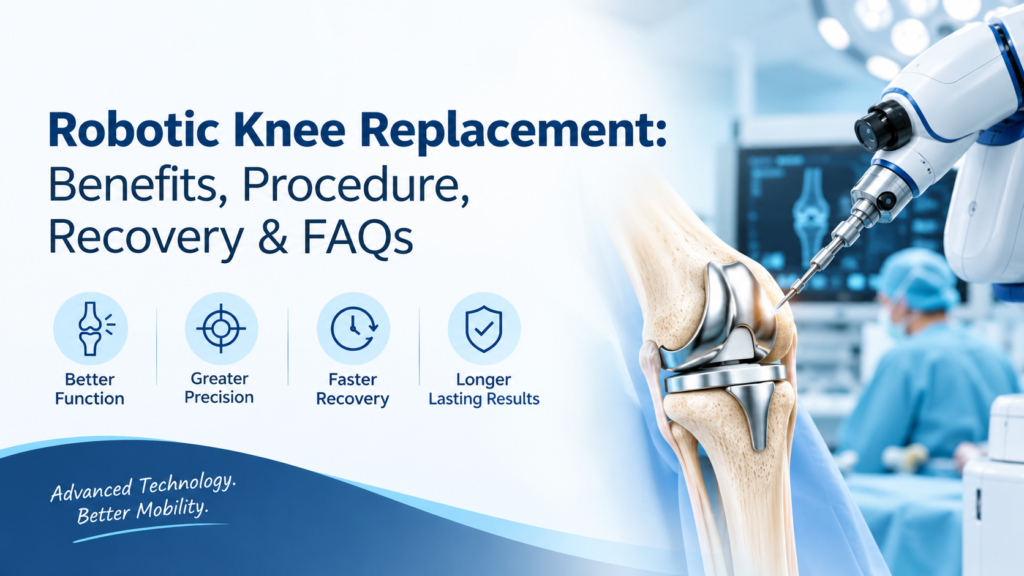
Today, advances in surgical technology have introduced robotic-assisted knee replacement, which can help surgeons with detailed planning and execution of the procedure.
But what exactly is robotic knee replacement? How is it different from conventional knee replacement? Who may benefit from it, and what can you expect during recovery?
Let’s understand.
What Is Robotic Knee Replacement?
Robotic knee replacement is a form of robotic-assisted joint replacement surgery in which advanced computer technology and a robotic system assist the surgeon during the procedure.
The technology can help the surgical team with:
- Pre-operative planning
- Assessment of the patient’s knee anatomy
- Planning bone preparation
- Implant positioning
- Alignment
- Intraoperative guidance
Importantly, the robot does not perform the surgery independently.
The orthopedic surgeon remains in control and uses the robotic system as a tool to assist with planning and surgical execution.
The exact technology and surgical technique can vary depending on the robotic system, implant, hospital, and surgeon.
Why Is Robotic Knee Replacement Used?
The knee is a complex joint, and every patient’s anatomy is different.
Robotic-assisted technology can provide the surgeon with detailed information about the patient’s knees and help with surgical planning.
The aim is to help the surgeon achieve accurate bone preparation, implant positioning, and alignment according to the planned procedure.
However, robotic assistance is not automatically necessary or better for every patient.
Whether it is appropriate depends on factors such as the patient’s diagnosis, anatomy, severity of arthritis, overall health, and the surgeon’s assessment.
Who May Need Knee Replacement?
Knee replacement is generally considered for patients with significant knee joint damage and symptoms that substantially affect daily life, particularly when appropriate non-surgical treatments have not provided sufficient relief.
Common conditions that may lead to knee replacement include:
- Advanced osteoarthritis
- Rheumatoid arthritis
- Post-traumatic arthritis
- Significant cartilage damage
- Other conditions causing severe joint deterioration
Typical symptoms may include:
- Persistent knee pain
- Pain while walking
- Difficulty climbing stairs
- Stiffness
- Swelling
- Reduced range of motion
- Difficulty standing for long periods
- Pain during rest or at night
- Reduced ability to perform everyday activities
Having these symptoms does not automatically mean you need knee replacement. An orthopedic evaluation is necessary to determine the appropriate treatment.
Robotic Knee Replacement vs Traditional Knee Replacement
Both procedures aim to replace damaged portions of the knee joint with artificial components. The key difference is the use of technology-assisted planning and guidance during robotic-assisted surgery.
| Robotic-Assisted Knee Replacement | Conventional Knee Replacement |
| Uses robotic/computer-assisted technology | Uses conventional surgical instruments |
| Detailed digital planning may be used | Planning is based on standard surgical methods |
| Technology can assist with bone preparation and implant positioning | Surgeon performs positioning using conventional techniques |
| Surgeon remains in control | Surgeon remains in control |
| May be suitable for selected patients | Widely used and appropriate for many patients |
The best approach depends on the individual patient rather than simply choosing the newest technology.
Benefits of Robotic-Assisted Knee Replacement
Depending on the technology and individual patients, potential advantages may include:
1. Detailed Surgical Planning
Robotic systems can assist the surgeon in creating a detailed plan based on the patient’s individual knee anatomy.
2. Assistance With Implant Positioning
Technology can provide guidance during the procedure to help the surgeon position components according to the surgical plan.
3. Individualized Approach
Because every knee is different, technology-assisted planning can help the surgeon account for individual anatomical characteristics.
4. Surgical Precision
Robotic assistance may help with controlled and precise bone preparation during the operation.
5. Potentially Improved Functional Outcomes
Some patients may experience good pain relief and improved function following knee replacement. However, outcomes depend on multiple factors and should not be attributed to robotic assistance alone.
Important: Robotic-assisted surgery does not guarantee a faster recovery, a pain-free result, or better outcomes for every patient.
How Is Robotic Knee Replacement Performed?
Although the exact procedure varies, robotic-assisted knee replacement generally involves several stages.
Step 1: Evaluation and Diagnosis
Your orthopedic surgeon evaluates your symptoms, medical history, knee movement, alignment, and overall health.
Imaging such as X-rays may be used to assess the condition of the knee.
Step 2: Surgical Planning
The surgeon uses the available imaging and robotic planning technology to create an individualized surgical plan.
The plan may help determine aspects such as:
- Bone preparation
- Implant size
- Implant positioning
- Alignment
- Balance of the knee
Step 3: Surgery
During surgery, the surgeon removes the damaged portions of the knee and prepares the joint for the artificial components.
The robotic system may provide real-time assistance or guidance, depending on the technology being used.
Step 4: Implant Placement
The selected implant components are positioned according to the surgical plan. The surgeon checks the knee’s movement, alignment, and stability before completing the procedure.
Step 5: Recovery Begins
After surgery, the patient is monitored and rehabilitation begins according to the hospital’s recovery protocol and the surgeon’s recommendations.
How Long Does Robotic Knee Replacement Take Surgery?
The duration of knee replacement surgery varies from patient to patient.
Factors such as:
- Surgical technique
- Patient anatomy
- Severity of joint damage
- Overall health
- Previous surgeries
- Complexity of the case
can influence the operating time.Your surgeon can provide a more individualized estimate after evaluating your knee.
Is Robotic Knee Replacement Less Painful?
Pain after knee replacement can vary significantly between individuals.
Modern knee replacement programs may use a combination of surgical techniques, anesthesia, medications, ice, physiotherapy, and early movement to manage postoperative pain.
While robotic assistance may help with surgical planning and execution, it should not be presented as a guarantee of less pain. Your recovery experience depends on several factors.
Robotic Knee Replacement Recovery
Recovery is an important part of the overall treatment. After surgery, your medical team may encourage appropriate movement and physiotherapy to help restore strength and mobility.
A typical recovery journey may include:
Surgery → Early movement → Physiotherapy → Strengthening → Increasing activity → Follow-up
The exact timeline varies from patient to patient.
Early Recovery
Initially, the focus is generally on:
- Pain management
- Wound care
- Safe movement
- Knee exercises
- Walking with appropriate support
- Preventing complications
Rehabilitation
Physiotherapy can help improve:
- Knee movement
- Muscle strength
- Balance
- Walking ability
- Functional independence
Following the rehabilitation program recommended by your medical team is an important part of recovery.
When Can You Walk After Robotic Knee Replacement?
Many patients are encouraged to begin moving and walking relatively soon after surgery, depending on their medical condition and the surgeon’s protocol. Initially, walking may require support such as a walker or crutches. As strength and confidence improve, the need for walking assistance can gradually decrease.
Do not compare your recovery with another patient’s.
Recovery speed varies considerably between individuals.
When Can You Return to Normal Activities?
Returning to normal activities is a gradual process. You may progressively resume activities such as:
- Walking
- Household activities
- Driving, when medically appropriate
- Low-impact exercise
- Swimming
- Cycling
The timing depends on your recovery and your surgeon’s advice. High-impact activities may not be appropriate for everyone after knee replacement.
Is Robotic Knee Replacement Safe?
Knee replacement is a commonly performed orthopedic procedure, but like any major surgery, it carries potential risks.
Possible complications can include:
- Infection
- Blood clots
- Bleeding
- Stiffness
- Persistent pain
- Implant-related problems
- Nerve or blood-vessel injury
- Need for further surgery
The risks vary depending on individual health and surgical circumstances. Your surgeon should explain the potential benefits and risks before you make a treatment decision.
Is Robotic Knee Replacement Suitable for Everyone?
No. Robotic-assisted knee replacement is not automatically the right choice for every patient.Your surgeon may consider:
- Severity of arthritis
- Knee alignment
- Joint damage
- Age and activity level
- Overall health
- Previous knee surgery
- Bone quality
- Individual anatomy
- Treatment goals
The decision should be based on your specific condition.
What Is the Difference Between Robotic-Assisted and Robot-Performed Surgery?
This is an important distinction.
Robotic-Assisted Surgery
The surgeon performs and controls the operation, while robotic technology helps with planning, positioning, and/or surgical guidance.
Fully Autonomous Robot Surgery
This would mean a robot independently performing the operation. Robotic knee replacement used in clinical practice is generally surgeon-controlled and technology-assisted, not an autonomous robot operating independently.
Does Robotic Knee Replacement Guarantee Better Results?
No surgical technology can guarantee a particular outcome.A successful knee replacement depends on several factors, including:
- Correct patient selection
- Surgical technique
- Implant choice
- Patient health
- Rehabilitation
- Physiotherapy
- Following postoperative instructions
- Individual healing
Robotic assistance is a tool that can support the surgeon it does not replace clinical judgment or patient-specific care.
How Long Does a Knee Replacement Last?
Modern knee replacement implants are designed for long-term use, but their lifespan varies.
Factors that may influence implant longevity include:
- Age
- Activity level
- Body weight
- Implant type
- Surgical factors
- Overall health
Your surgeon can explain the expected longevity of the implant used in your case.
7 Signs You May Need to Discuss Knee Replacement
Consider speaking with an orthopedic specialist if you experience:
1. Persistent knee pain
Pain continues despite appropriate treatment.
2. Difficulty walking
You cannot walk comfortably or for your usual distance.
3. Night or rest pain
Knee pain interferes with sleep or occurs even when resting.
4. Significant stiffness
You struggle to bend or straighten your knees.
5. Repeated swelling
Your knee frequently becomes swollen or inflamed.
6. Difficulty with everyday activities
Stairs, chairs, shopping, travelling, or household activities become difficult.
7. Reduced quality of life
You have stopped doing activities you enjoy because of your knee. These signs do not automatically mean you need surgery. They indicate that an orthopedic assessment may be worthwhile.
How Can You Prepare for Knee Replacement?
If surgery is recommended, preparation can play an important role.Your medical team may advise you to:
- Maintain an appropriate body weight
- Follow prescribed exercises
- Control existing medical conditions
- Review medications with your doctor
- Prepare your home for postoperative mobility
- Arrange help during the early recovery period
- Understand your physiotherapy plan
Your hospital will provide specific instructions based on your health and planned procedure.
Frequently Asked Questions About Robotic Knee Replacement
Is robotic knee replacement better than normal knee replacement?
Robotic-assisted surgery offers technology-assisted planning and surgical guidance, but it is not automatically better for every patient. The appropriate approach depends on your individual condition and your surgeon’s assessment.
Is robotic knee replacement more expensive?
The cost can vary depending on the hospital, implant, robotic system, surgeon, investigations, hospital stay, and other factors. Ask your hospital for an individualized estimate.
Is robotic knee replacement suitable for older adults?
Age alone does not determine suitability. Your overall health, knee condition, mobility, and surgical requirements are important considerations.
How soon can I walk after knee replacement?
Many patients begin walking with assistance relatively early after surgery, depending on their condition and medical team’s protocol.
How long does recovery take?
Recovery varies from person to person. Rehabilitation continues progressively after discharge, and improvement can continue for several months.
Can I climb stairs after knee replacement?
Many patients can use stairs again after recovery. Your physiotherapist will guide you on safe techniques and progression.
Can I do yoga after knee replacement?
Some patients can return to modified yoga after recovery, but the exercises should be appropriate for the replaced joint and cleared by the treating team.
Can robotic knee replacement be avoided?
Robotic assistance is a surgical technology, not a requirement for every knee replacement. Your surgeon can explain whether it offers a meaningful advantage in your particular case.
Should I wait until my knee pain becomes unbearable?
You don’t necessarily need to wait until pain becomes unbearable. If knee pain is persistent or affecting your daily life, an earlier evaluation can help you understand your treatment options.
Final Takeaway
Robotic knee replacement combines the experience of an orthopedic surgeon with advanced technology to assist with surgical planning and execution.It may be an appropriate option for selected patients with advanced knee joint damage and significant symptoms.
However, robotic surgery is not a solution for every type of knee pain, and not every patient with arthritis needs knee replacement. The first step is understanding the condition of your knee and discussing all appropriate treatment options with an experienced orthopedic specialist.
Don’t Let Knee Pain Limit Your Life
If persistent knee pain affects your walking, sleep, exercise, or everyday activities, consider getting your knee evaluated.
Understand your diagnosis.
Explore your treatment options.
Make an informed decision about your knee health.
Consult an Orthopedic Specialist at Guardian Hospital, Ambala.
This article is intended for general educational purposes and does not replace individual medical consultation. Treatment suitability, risks, benefits, and expected recovery vary between patients.
Reviewed by Rahul Singh (Orthopaedic)

Leave feedback about this